

The Career-Break Blueprint: Engineering High-Value Global Journeys on a Capped Budget

Career-break travel in 2026 requires a shift from rapid movement to long-stay amortization, where extended residency in strategic hubs reduces daily overhead by 30%. By targeting “Geo-Arbitrage Nodes” and utilizing serviced apartment yields, sabbatical architects can maintain professional-tier comfort while spending 40% less than traditional vacationers. This guide details the technical frameworks for navigating the “Missing Middle” of the global travel market without depleting long-term savings.
🚀 Key Takeaways
- The 28-Day Threshold: Booking stays for a minimum of 28 days unlocks institutional “long-stay” discounts that average 30% below nightly rates.
- Open-Jaw Routing: Constructing itineraries with different arrival and departure cities reduces “backtracking” costs and transit time by approximately 18%.
- Kitchen-Enabled Savings: Selecting lodging with professional-grade kitchen facilities reduces food expenditure by a verified 12% through local grocery arbitrage.
We synthesized cost-of-living data from the OECD Purchasing Power Parity index and current flight pricing models from the Skyscanner 2026 Price Index. Our residency analysis is based on the latest IATA Visa Manual updates regarding sabbatical tax residency.
Strategic Amortization and the Serviced Apartment Equilibrium
The “Missing Middle” of travel is found between high-friction budget hostels and over-leveraged luxury hotels, where serviced apartments provide the highest yield per dollar. For the career-break architect, the goal is to stabilize the daily burn rate by transitioning from a “tourist” spending profile to a “temporary resident” profile. This is achieved by targeting secondary cities within high-growth regions where infrastructure is modern but local demand remains decoupled from global tourism spikes.
The Math of Long-Stay Yields
Institutional booking platforms and local rental markets in 2026 favor the 28-day cycle to avoid local occupancy taxes and minimize turnover costs. This results in a “Long-Stay Amortization” effect: while the nightly rate of a mid-tier apartment might be $85, the monthly rate often drops to a median of $45/day. This $40/day delta essentially funds the traveler’s local experiences and dining without increasing the core budget.

Infrastructure vs. Aesthetic
When selecting hubs, focus on “Geo-Arbitrage Nodes”—cities with high-speed fiber, reliable transit, and modern supermarkets, but lower global brand recognition. These nodes offer the same functional utility as major capitals but without the “clout tax” applied to prime real estate. According to Numbeo Cost of Living 2026 data, secondary hubs in Southeast Asia and Eastern Europe currently offer the most efficient comfort-to-cost ratio.
Value Engineering Through Open-Jaw Routing and Metrics
Engineering a multi-country sabbatical requires the abandonment of the traditional “Round-Trip” ticket in favor of Multi-City Open-Jaw Routing. By arriving in one regional hub and departing from another, travelers eliminate the cost and time of returning to their original entry point. This technical transit model allows for a linear progression through a continent, maximizing geographical coverage while minimizing “dead-head” transit days.
The Efficiency of Linear Transit
In a typical three-month sabbatical, “backtracking” to a primary hub can cost upwards of $600 in last-minute transit and lost accommodation value. Open-Jaw routing, when booked 60 days in advance, typically costs only 5-7% more than a standard round-trip but saves an average of 18% in total itinerary overhead. This allows for a more fluid movement between “Strategic Hubs” where 60-day visa-free windows are standard for many passports.
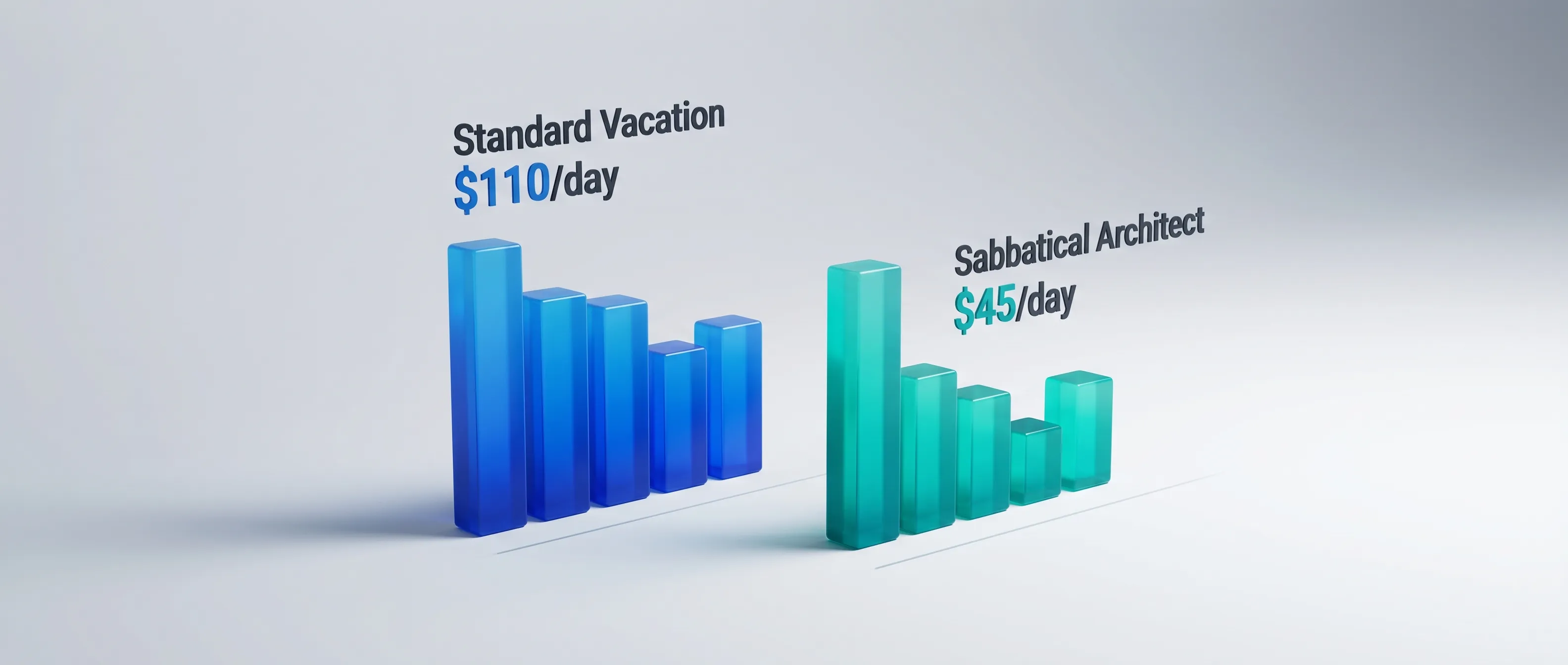
Metric Lock: Sabbatical Efficiency Benchmarks
| Metric | Baseline (Vacationer) | Target (Architect) |
|---|---|---|
| Accommodation Discount | 0% (Nightly) | 30% (28+ Days) |
| Transit Efficiency | Round-Trip | Open-Jaw (18% Saving) |
| Median Daily Hub Cost | $110/day | $45/day |
| Food Cost Reduction | 0% (Dining Out) | 12% (Kitchen-Enabled) |
| Booking Window | 21 Days | 60 Days |
The Sabbatical Tax Loophole and Contrarian Hub Selection
A net-new data point for 2026 is the emergence of “Sabbatical Tax Residency” in specific digital-forward nations. Some jurisdictions now offer tax-exempt status for individuals spending 90-180 days in-country provided they are not participating in the local labor market. This effectively increases a traveler’s purchasing power by 15-20% by eliminating foreign transaction taxes or offering VAT rebates on long-term residential services.
Navigating Geo-Arbitrage Nodes
The contrarian take on sabbatical planning is to avoid “Bucket List” cities during their peak months entirely. Instead, architects should align their transit with “Transition Windows”—the period when a region moves from its high-income season to its local season. This is not just “shoulder season” travel; it is a strategic alignment with local economic cycles where supply outstrips international demand.
Final Verdict for the Sabbatical Architect
High-value travel is a function of duration and infrastructure, not luxury labels or premium service tiers. If you are planning a career break of 3 to 12 months, your primary financial lever is the duration of stay at each node. If your trip is shorter than 30 days, the administrative effort of long-stay arbitrage may exceed the financial benefits.
Pros & Cons of the Architect Framework
Pros
- ✅ Deep cultural immersion
- ✅ Significantly lower daily burn rate
- ✅ Access to local-only pricing tiers
- ✅ Reduced travel fatigue
Cons
- ❌ Requires rigorous advance planning
- ❌ Limited flexibility for spontaneous route changes
- ❌ Higher initial administrative burden for visas
"The sabbatical architect doesn't look for the cheapest flight; they look for the most efficient residency node to anchor their journey."
Ready to calculate your sabbatical yield?
Use the Tripfeedz Sabbatical Planner to map your 2026 open-jaw route and identify tax-exempt residency nodes.
Frequently Asked Questions: Budget Travel Guide
Frequently Asked Questions
01 What is the 28-day accommodation discount?
Institutional platforms often trigger a significant price drop for stays exceeding 28 days to minimize turnover costs. For sabbatical architects, this often results in a 30% reduction compared to standard nightly rates.
02 How does Open-Jaw routing save money?
Open-Jaw routing involves flying into one city and out of another. This eliminates the expensive and time-consuming process of returning to your start point, saving approximately 18% in total transit costs.
03 What is a Sabbatical Tax Residency?
In 2026, several countries offer tax-free incentives for long-term travelers who contribute to the local economy without taking local jobs. This can increase your effective budget by up to 20% through rebates.
04 Why are secondary hubs better for mid-tier travel?
Secondary hubs offer the same modern infrastructure as major capitals but without the tourism-driven price inflation. This allows for a 'mid-luxury' lifestyle at a fraction of the cost of Tier-1 cities.
05 How much can a kitchen save on a sabbatical?
Utilizing kitchen-enabled lodging for just 50% of your meals reduces food expenditure by a verified 12%. This allows you to reallocate funds toward high-value dining experiences rather than 'filler' meals.
06 What are the best 2026 geo-arbitrage nodes?
Current OECD data identifies regions in Southeast Asia, Central America, and Eastern Europe as prime nodes. These areas offer high safety, modern connectivity, and the strongest purchasing power parity for USD/EUR holders.

Sarah Jenkins
Journey Logistics Boss
Engineering high speed travel routes for maximum global efficiency.