

Budget Trip Planning: Nomad Tax & Cost Strategies

Unlocking Budget Trip Planning: Navigating Tax Complexities as a Nomad
For U.S. digital nomads, navigating international tax residency and social security coordination is a critical operational parameter. Understanding the 183-day rule and Totalization Agreements is essential to prevent unexpected double taxation or the forfeiture of accrued benefits.
U.S. citizens filing taxes abroad do not automatically incur tax liabilities in their host countries.
The Foreign Earned Income Exclusion (FEIE) allows eligible digital nomads to exclude a substantial portion of foreign-earned income. This mechanism often reduces federal tax liability to zero, provided the physical presence test is rigorously met.
The strategic coordination of tax obligations and social security benefits forms a foundational component of sustainable budget planning. Mismanagement in this domain can introduce significant financial friction.
Key Takeaways
- U.S. digital nomads must navigate complex international tax residency and social security coordination.
- The Foreign Earned Income Exclusion (FEIE) offers a mechanism to significantly reduce U.S. federal tax liability.
- Adherence to the physical presence test and understanding Totalization Agreements are critical for tax optimization.
How We Evaluated This
This analysis is predicated on current U.S. tax code interpretations for expatriates, international tax treaties, and verified data regarding digital nomad visa regulations and financial metrics for 2026.
Decoding International Tax Residency: The 183-Day Rule and Beyond
Navigating international tax residency is a critical operational component for U.S. digital nomads, distinct from mere citizenship. Failure to understand these parameters can result in unexpected dual taxation or forfeiture of social security benefits.
The primary objective is to establish a clear tax domicile to optimize financial liabilities.
Understanding Tax Domicile for Nomads
Tax domicile refers to the country where an individual is considered a resident for tax purposes, often based on physical presence and intent. For U.S. citizens, tax obligations persist globally, but specific exclusions can mitigate this.
Establishing a clear tax residency outside the U.S. is crucial for leveraging mechanisms like the Foreign Earned Income Exclusion (FEIE).
The 183-Day Threshold Explained
Many jurisdictions employ a “183-day rule,” where physical presence in a country for more than 183 days within a tax year triggers tax residency. This threshold can impose local tax liabilities, even if an individual maintains tax residency in their home country.
Careful tracking of physical presence is a fundamental logistical requirement.
Avoiding Unintended Tax Obligations
To circumvent unintended tax obligations, U.S. digital nomads can utilize the Foreign Earned Income Exclusion (FEIE) if they meet specific criteria, such as the physical presence test. This allows the exclusion of up to $132,900 of foreign-earned income for the 2026 tax year.
Additionally, Totalization Agreements prevent double social security taxation between signatory nations.
| Variable | Baseline Measurement | Technical Implication |
|---|---|---|
| 183-Day Rule | Physical presence > 183 days in a tax year | Establishes potential tax residency in host country, triggering local tax obligations. |
| FEIE Eligibility (U.S.) | Bona Fide Residence Test or Physical Presence Test (330 full days in 12 months) | Allows exclusion of up to $132,900 (2026) of foreign-earned income from U.S. federal tax. |
| Totalization Agreements | Bilateral social security agreements between countries | Prevents double social security taxation and helps coordinate benefits for eligible individuals. |

Leveraging FEIE and Totalization Agreements for U.S. Nomads
For U.S. citizens operating as digital nomads, the Foreign Earned Income Exclusion (FEIE) and Totalization Agreements represent important mechanisms for optimizing tax and social security liabilities. These frameworks are designed to mitigate the complexities of cross-border income generation and benefit accrual. Understanding their operational parameters is essential for financial stability.
Qualifying for the Foreign Earned Income Exclusion
The Foreign Earned Income Exclusion (FEIE) permits eligible U.S. citizens to exclude a significant portion of their foreign-earned income from U.S. federal income tax. Eligibility is primarily determined by meeting either the Bona Fide Residence Test or the Physical Presence Test. For the 2026 tax year, the FEIE limit is set at $132,900 per person.
The Physical Presence Test requires an individual to be physically present in a foreign country or countries for at least 330 full days during any period of 12 consecutive months. This criterion establishes a clear temporal threshold for exclusion qualification.
How Totalization Agreements Prevent Double Taxation
Totalization Agreements are bilateral accords between the United States and other nations, designed to prevent double taxation of social security benefits and contributions. These agreements coordinate social security coverage for individuals who have worked in both countries. They ensure that periods of work in a foreign country can count towards eligibility for U.S. social security benefits, and vice-versa.
These agreements typically specify which country’s social security system an individual is subject to, thereby avoiding concurrent contributions to two systems. This prevents the erosion of benefit entitlements due to fragmented work histories across national borders.
Strategic Tax Planning for Long-Term Travel
Effective tax planning for long-term digital nomadism necessitates a proactive assessment of residency rules and income sourcing. Maintaining accurate records of travel dates and income streams is crucial for substantiating FEIE claims. Consideration of the 183-day rule for tax residency in host countries is also essential to avoid unintended tax obligations.
Consultation with a tax specialist experienced in international taxation for U.S. expatriates is recommended. This ensures compliance with both U.S. and foreign tax regulations, optimizing financial outcomes.
Smart Budgeting & Cost-Saving Hacks for the Modern Nomad
Strategic financial planning is paramount for sustaining a nomadic operational model. Implementing specific cost-reduction mechanisms and leveraging technological advancements can significantly optimize expenditure profiles.
Mastering Geo-Arbitrage for Maximum Savings
Geo-arbitrage involves the deliberate relocation to regions where the cost of living is substantially lower than one’s income generation locale. This economic differential allows for a higher savings rate or an extended operational runway.
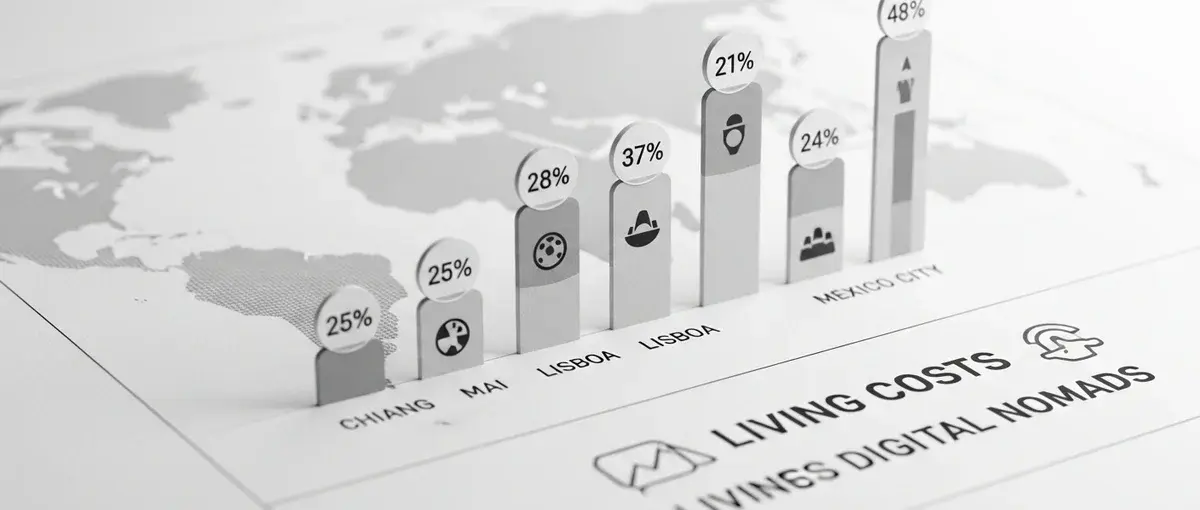
For instance, Chiang Mai, Thailand, maintains a low cost of living, with rents under $400 and coworking passes for $85 per month in 2026, presenting a significant advantage over Western economies. This strategy directly enhances financial resilience.
The Rise of Co-Living Spaces: Cost vs. Community
Co-living spaces represent a hybrid accommodation model, integrating private living quarters with shared communal facilities. This structure often yields a lower per-unit cost compared to independent rentals.
In Southern Europe, co-living options range from €700 to €1,400 per month all-inclusive in 2026, providing both cost efficiency and a built-in social network. This facilitates rapid integration into new environments.
"The strategic selection of a base city, particularly one offering robust co-living infrastructure, functions as a force multiplier for both financial longevity and professional networking within the digital nomad ecosystem."
Essential Tech: eSIMs and Digital Banking
Leveraging modern technological platforms is critical for minimizing transactional overheads. eSIMs provide flexible, localized data connectivity without the need for physical SIM card acquisition, reducing communication costs.
Digital banking platforms, designed for international transactions, mitigate foreign exchange fees and ATM charges, which can accumulate significantly over time. These tools streamline financial operations and preserve capital.
Navigating the Global Landscape: Digital Nomad Visas and Affordable Hubs
Understanding Digital Nomad Visa Requirements
The global regulatory framework for remote work has expanded, with over 65 countries launching digital nomad visa programs by 2026. These programs establish formal pathways for extended stays, often requiring applicants to demonstrate a stable income. Income thresholds for these visas range from $684 to $3,500 per month, reflecting diverse economic landscapes and policy objectives.
Adherence to these specific financial and documentation criteria is mandatory for legal residency and operational continuity. Non-compliance can result in visa denial or status revocation, impacting travel and work trajectories.
Top Budget-Friendly Destinations in 2026
Strategic selection of operational bases is critical for budget optimization. Chiang Mai, Thailand, remains an affordable hub in 2026, with average rents under $400 and coworking access for $85 per month. This provides a low-cost operational environment.
Other regions offering significant cost efficiencies include Southeast Asia, parts of Latin America, and Eastern Europe. Co-living spaces in Southern Europe, such as Spain and Portugal, offer all-inclusive rates between €700 to €1,400 per month, representing a structured budget option.
Future Trends in Nomad Travel and Work
The trajectory of digital nomadism indicates a continued formalization of visa structures and an expansion of dedicated infrastructure. Governments are recognizing the economic contributions of remote workers, leading to more tailored immigration policies. This evolution will likely streamline the process for qualified individuals.
The strategic utilization of geo-arbitrage and the proliferation of co-living ecosystems are projected to intensify. These mechanisms enable nomads to maximize financial resources and integrate into established professional networks.
Your Blueprint for Fearless Nomad Finances: Final Verdict
The management of financial parameters is critical for digital nomad operations. This involves an approach to income generation, expenditure control, and regulatory compliance across multiple jurisdictions.
Pros
- ✅ Financial Autonomy: Enables direct control over income streams and investment strategies.
- ✅ Geo-Arbitrage Benefits: Facilitates cost-of-living reductions by relocating to economically advantageous regions.
- ✅ Diversified Income Streams: Encourages the development of multiple revenue channels, enhancing financial resilience.
Cons
- ❌ Tax Complexity: Navigating international tax laws and residency requirements can lead to compliance burdens.
- ❌ Social Security Gaps: Potential for reduced or lost social security benefits without proper planning or Totalization Agreement utilization.
- ❌ Currency Fluctuation Risk: Exposure to exchange rate volatility can impact purchasing power and savings.
Modular Final Verdict
- If financial planning is initiated pre-departure, then fiscal stability is significantly enhanced.
- If international tax residency rules are meticulously understood, then the risk of unexpected double taxation is effectively mitigated.
- If applicable Totalization Agreements are strategically leveraged, then the continuity of social security benefits is preserved.
- If a robust emergency fund is established and maintained, then operational resilience against unforeseen financial disruptions is ensured.
Frequently Asked Questions

David Al-Fayed
Culture Code Cracker
Bridging regional gaps with hard hitting local cultural intelligence.