The True-Cost Manual: Navigating Airline Ancillary Fees and Booking Hacks in 2026
The era of the “Base Fare” is effectively over, as 2026 airline pricing models now rely on unbundled service fees that can inflate the final checkout price by up to 150%. Savvy travelers must look past the initial search result and perform a forensic audit of baggage costs, seat selection surcharges, and payment processing fees to find the genuine lowest price. While aggregators show a “lead price,” the hidden “Ancillary Attachment Rate” is where the true financial impact lies.
🚀 Key Takeaways
- Total Cost Audit: Always calculate the “Landing Price” including a $45 standard baggage fee before comparing different carriers.
- Algorithmic Defenses: Avoid “Anxiety Seating” fees by utilizing the DGCA 48-hour free window for schedule changes or cancellations.
- Fuel Surcharge Awareness: Monitor ATF (Aviation Turbine Fuel) price trends, as carrier-imposed surcharges now fluctuate weekly based on global oil indices.
Our analysis is based on the 2026 Ancillary Market Trends and DGCA Fare Transparency Rules. We cross-referenced 2026 Baggage Fee Comparison data with real-time ATF Price Shock Analysis to provide a data-driven framework for cost-effective booking.
Decoding the 2026 Ancillary Fee Architecture
Modern flight booking is no longer a simple transaction; it is an encounter with high-frequency Dynamic Service Fees designed to maximize carrier revenue at every click. Ancillary revenue now accounts for over 30% of total airline income, shifting the burden of profitability from the ticket price to the passenger’s specific needs. Carriers utilize complex PNR-linking data to track your behavior and adjust the price of “add-ons” based on your search history and device type.
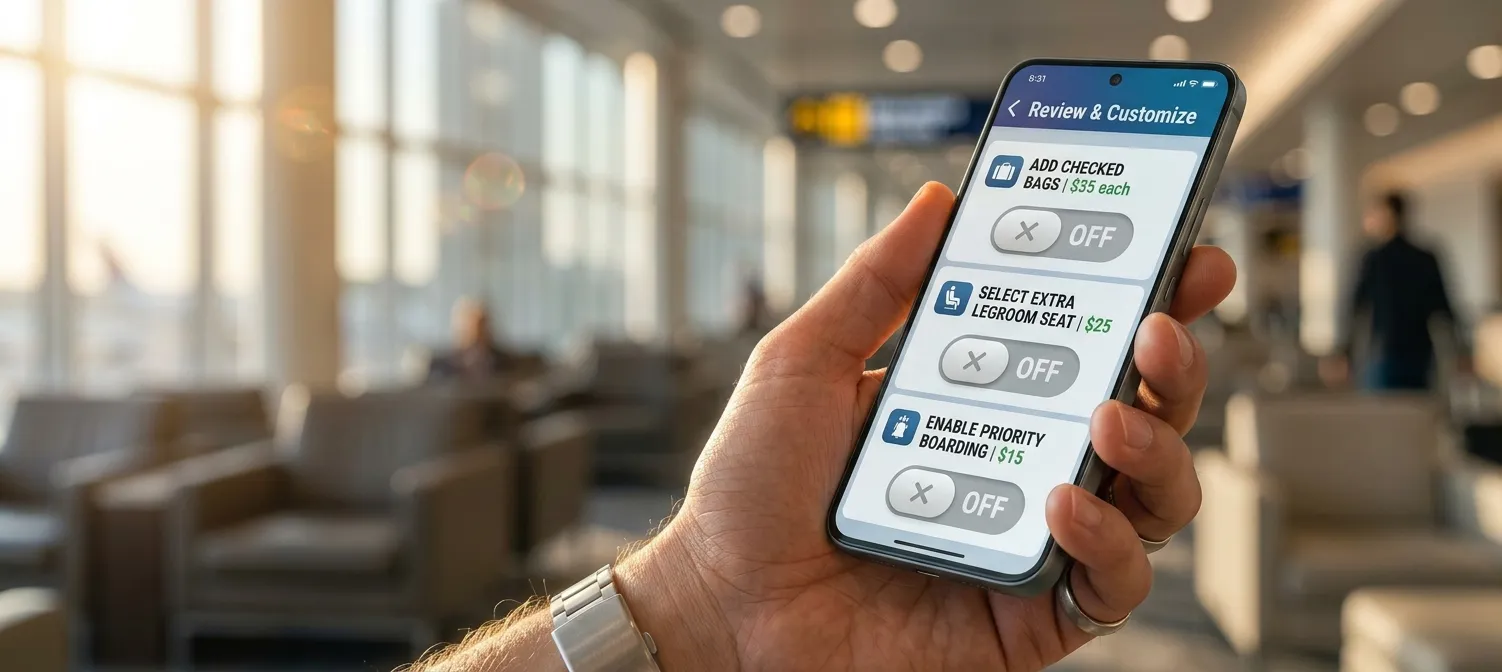
The most aggressive growth in 2026 is seen in the “Bait and Switch” pricing model. A traveler might find a transcontinental flight for $299, only to discover that adding a single checked bag ($45) and a standard window seat ($25) increases the price by nearly 25%. This “unbundling” is a psychological tactic to lower the barrier to entry while capturing high-margin profit at the checkout screen.
To counter this, travelers must use “Total-Cost” filters on search engines. These tools allow you to input your baggage and seating requirements before the search results are generated. This prevents the “anchoring effect,” where your brain fixates on an impossible-to-attain base fare, leading to a higher likelihood of accepting overpriced add-ons later in the funnel.
Combatting Algorithmic “Anxiety Seating”
Airlines are increasingly using “Anxiety Seating” algorithms that intentionally separate passengers booked on the same PNR to force paid seat assignments. These systems identify families or couples traveling together and present a seat map where no two adjacent seats are “free.” This creates an artificial scarcity that triggers a panic purchase, even when dozens of adjacent seats are actually available for airport assignment.
| Metric Component | 2026 Market Standard | Impact on Total Price |
|---|---|---|
| 1st Checked Bag | $45 (Global Average) | +15-20% |
| Ancillary Revenue Share | 30% of Total Income | High |
| Max Checkout Hike | 150% over Base Fare | Extreme |
| ATF Price Impact | ₹2 Lakh / KL (Record) | Variable Surcharge |
| Free Change Window | 48 Hours (DGCA/14+ Days) | Regulatory Buffer |
To beat the algorithm, check the seat map 24 hours before departure during the online check-in window. Airlines often release blocked “Preferred” seats for free to balance the aircraft’s weight and trim. If you are separated from your party, wait for the gate agent rather than paying the inflated 2026 online “convenience” fee, which can now reach $35 per segment.
The ATF Price Shock and Regulatory Defenses
The 2026 aviation landscape is defined by the “ATF Price Shock,” where record-high fuel costs of ₹2 Lakh per Kiloliter are passed directly to consumers via Carrier-Imposed Surcharges. Unlike the base fare, these surcharges are often non-refundable and are adjusted dynamically. Understanding the ATF Price Shock Analysis is essential for timing your purchase during fuel price dips.
"The ticket price you see is a marketing tool; the fees you pay are the business model. In 2026, the only way to save is to refuse the digital upsell at the point of sale."
Fortunately, regulatory bodies have introduced protections. In India, DGCA Fare Transparency Rules now mandate a 48-hour free cancellation window for flights booked at least 14 days in advance. This allows travelers to lock in a “bait price” while they perform a secondary audit for better “Total Cost” alternatives without financial risk.
Final Value Assessment for Travelers
Successful flight booking in the current economy requires a shift from ‘finding the lowest fare’ to ‘minimizing the total landing cost.’ Your decision-making should be governed by the specific mechanics of your trip, specifically your baggage needs and the duration of the flight. If you cannot travel with only a personal item, a “Budget” carrier may actually be more expensive than a “Full Service” airline once the $45 baggage fee is applied.
- IF you are traveling with a checked bag: THEN prioritize Full-Service carriers where the “All-Inclusive” fare often beats the “Budget + Add-ons” price.
- IF you are traveling solo and light: THEN use Budget carriers but strictly decline all ancillary prompts.
Pros
- ✅ Transparent unbundling allows for extreme savings for 'Ultra-Light' travelers
- ✅ Greater flexibility in choosing only services you require
- ✅ High competition on popular routes keeps base fares low
Cons
- ❌ High potential for 'hidden' costs at final checkout
- ❌ Complexity in comparing 'Apples-to-Apples' across airlines
- ❌ Aggressive 'Anxiety Seating' separates groups and families
Frequently Asked Questions: Flight Booking Tips
Frequently Asked Questions
01 What is the best day to book flights in 2026?
Booking on Tuesday or Wednesday remains effective, but true savings come from monitoring ATF fuel surcharges. Aim for 4-6 weeks out to balance price floor and seat availability.
02 How much are baggage fees in 2026?
The 2026 global average for a first checked bag is approximately $45. Look for full-service bundles or specific credit card perks to offset these high-margin ancillary costs.
03 What is 'Anxiety Seating' and how do I avoid it?
Airlines split groups on the same PNR to force paid seat upgrades. Avoid this by checking in exactly 24 hours early or waiting for free gate assignments at the airport.
04 Can I cancel a flight for free within 48 hours?
Under DGCA Transparency Rules, you can cancel for free within 48 hours if booked 14+ days ahead. Use this window to lock prices while auditing for better total-cost alternatives.
05 Are budget airlines always cheaper than full-service?
No. Once you add $45 baggage and $25 seat fees, budget prices often exceed full-service fares. Always calculate the 'Total Landing Cost' before making your final airline selection.
06 How do fuel prices affect my ticket cost?
ATF at ₹2 Lakh per KL drives up 'Carrier-Imposed Surcharges.' These dynamic fees can constitute a large portion of your ticket, especially on long-haul international routes with high fuel consumption.

Diego Fernandez
Transit Grid Master
Decoding massive global transit networks for maximum route speed.