
How to Get a Schengen Visa in 2026: Step-by-Step Guide
Have you been dreaming of walking through the streets of Paris, watching the Northern Lights in Finland, or enjoying a gondola ride in Venice? If yes, the first thing you’ll need is a Schengen Visa.
For many people, applying for a Schengen Visa feels confusing. There are different documents, embassy rules, appointments, and plenty of information online that can make the process look harder than it actually is.
The good news is that getting a Schengen Visa in 2026 is quite straightforward if you know the right steps. While Europe has introduced new digital border systems in 2026, the visa application process for Indian travellers remains largely the same. The key is submitting the correct documents and applying well in advance.
What is a Schengen Visa?
A Schengen Visa is a short-stay visa that allows you to travel to most European countries that are part of the Schengen Area. With a single visa, you can visit multiple Schengen countries without going through border checks between them.
A standard Schengen Visa allows you to stay for up to 90 days within any 180-day period for purposes like tourism, business meetings, family visits, or short courses. The same visa rules apply across all Schengen countries.
Which Schengen Visa Should You Apply For?
The type of visa depends on the purpose of your trip.
| Visa Type | Purpose | Maximum Stay |
|---|---|---|
| Tourist Visa | Holidays and sightseeing | Up to 90 days |
| Business Visa | Meetings, conferences and business trips | Up to 90 days |
| Family or Friend Visit Visa | Visiting relatives or friends | Up to 90 days |
| Airport Transit Visa | Transit through selected Schengen airports | Airport transit only |
| National (Type D) Visa | Study, work or long-term stay | More than 90 days |
If you’re travelling for a holiday, the Type C Tourist Visa is the one you’ll most likely need.
Step 1: Decide Which Country Will Process Your Visa
One of the biggest mistakes applicants make is applying to the wrong embassy. You should apply through the country where you will spend the most number of days. If you’re spending the same number of days in two or more countries, apply through the country where you’ll enter the Schengen Area first.
For example, if your trip includes five days in Italy and three days in France, you should apply through the Italian embassy or its visa application centre. Planning your itinerary correctly at this stage can save you unnecessary delays later.
Step 2: Book Your Visa Appointment
Once your travel plans are ready, book an appointment with the embassy, consulate, or authorised visa application centre such as VFS Global or BLS, depending on the country you’re visiting.
Appointments can fill up quickly during the summer holidays and festive seasons. That’s why experts recommend applying at least 45 to 60 days before your departure, although applications are generally accepted up to six months before travel.
"Applying at least 45 to 60 days before your departure gives you enough time to arrange documents and deal with unexpected delays — especially during peak summer and festive travel seasons."
Step 3: Gather All Required Documents
Your documents play the biggest role in deciding whether your visa is approved. Even a small mistake or missing document can lead to delays or rejection.
Here’s the standard checklist.
| Document | Why It's Needed |
|---|---|
| Valid Passport | Must be issued within the last 10 years and remain valid for at least three months after your return |
| Completed Visa Application Form | Filled correctly and signed |
| Recent Passport-size Photographs | As per Schengen photo specifications |
| Flight Reservation | Proof of your travel plans |
| Hotel Booking or Invitation Letter | Shows where you'll stay |
| Travel Insurance | Minimum medical coverage of €30,000 across the Schengen Area |
| Bank Statements | Usually for the last 3–6 months |
| Salary Slips or Income Proof | Shows financial stability |
| Employment Letter or Business Proof | Confirms your occupation |
| Cover Letter | Explains your travel plans and purpose of visit |
Make sure every document matches your travel dates. Any mismatch between your itinerary, hotel bookings, or flight reservations may raise questions during processing.
Step 4: Buy Schengen Travel Insurance
Travel insurance is not optional — it is mandatory. Your insurance policy must provide at least €30,000 in medical coverage and be valid across all Schengen countries for the entire duration of your trip.
It should also cover emergency medical treatment, hospitalisation, and repatriation if needed. Many applicants purchase insurance only after collecting the rest of their documents because the policy dates should match their planned travel dates.
Step 5: Attend Your Visa Appointment
On the appointment day, carry both your original documents and photocopies. A visa officer will verify your paperwork, collect your passport, take your fingerprints and photograph (biometric data), and ask a few simple questions about your trip if required.
If you’ve previously provided biometrics for a Schengen Visa, you may not always need to submit them again, depending on your previous application and the applicable rules. Answer every question honestly and confidently. Keep your responses consistent with the information you’ve submitted in your application.
Step 6: Wait for Your Visa Decision
After your appointment, your application goes through verification. In most cases, a decision is made within 15 calendar days, although applications requiring additional checks can take longer.
During busy travel seasons, processing may extend beyond the standard timeline, so applying early is always a smart choice. Most visa application centres also allow you to track your application online using your reference number. Once approved, your passport will be returned with the Schengen Visa sticker, mentioning the validity period, number of entries, and permitted duration of stay.
Schengen Visa Fees in 2026
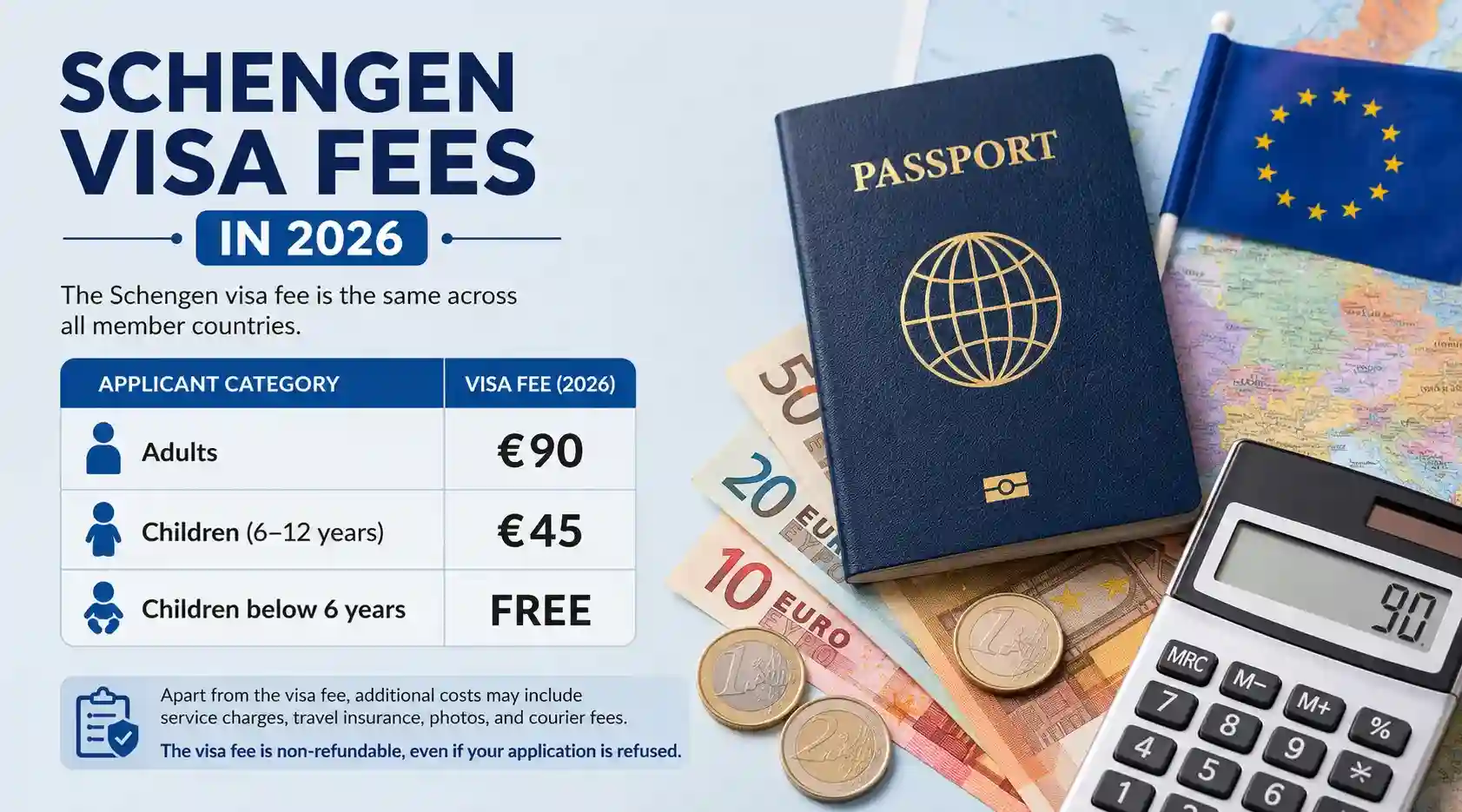
The Schengen visa fee is the same across all member countries, although you may also have to pay an additional service charge if you apply through a visa application centre such as VFS Global or BLS.
| Applicant Category | Visa Fee (2026) |
|---|---|
| Adults | €90 |
| Children (6–12 years) | €45 |
| Children below 6 years | Free |
Apart from the visa fee, remember to budget for travel insurance, passport photographs, courier charges (if applicable), and the visa application centre’s service fee. The total cost for most applicants from India usually falls between ₹12,000 and ₹18,000, depending on the country and the services you choose. The visa fee is non-refundable, even if your application is refused.
Why Are Some Schengen Visa Applications Rejected?
Although thousands of visas are approved every day, some applications are refused because of avoidable mistakes.
One common reason is submitting incomplete or incorrect documents. Missing bank statements, unsigned forms, or inconsistent travel plans can raise concerns.
Another reason is weak financial proof. The embassy must be satisfied that you have enough money to cover your travel, accommodation, food, and other expenses during your stay.
Applicants may also face rejection if they cannot clearly explain the purpose of their trip or if the authorities believe there is a risk that they may not return to their home country before the visa expires.
Providing fake hotel bookings, false employment documents, or misleading information almost always leads to refusal and may affect future visa applications as well.
Tips to Improve Your Chances of Visa Approval
Applying for a Schengen Visa isn’t about luck. A well-prepared application makes a big difference.
Pros
- ✅ Apply 45 to 60 days before departure to avoid last-minute delays
- ✅ Ensure your passport has sufficient validity and blank pages
- ✅ Maintain a stable bank balance for several months before applying
- ✅ Keep your itinerary, hotel nights, and flight bookings aligned
- ✅ Double-check every document for spelling errors and mismatched dates
Cons
- ❌ Waiting until the last minute during peak travel seasons
- ❌ Making large last-minute deposits that look suspicious
- ❌ Submitting incomplete or unsigned application forms
- ❌ Using fake hotel bookings or misleading employment documents
- ❌ Inconsistent answers at the visa appointment versus your application
Start by applying early rather than waiting until the last minute. This gives you enough time to arrange documents and deal with any unexpected delays.
Make sure your passport has sufficient validity and blank pages before applying.
Keep your bank account healthy for several months before your application instead of making large last-minute deposits. A stable financial history looks more genuine than a sudden increase in balance.
Your travel itinerary should also make sense. The number of hotel nights should match your flight bookings, and your cover letter should clearly explain your travel plans.
Finally, double-check every document before your appointment. Even small mistakes like spelling errors or mismatched dates can slow down the process.
Conclusion
Getting a Schengen Visa in 2026 is much easier when you understand the process and prepare your documents carefully. The application procedure has remained largely the same, although Europe’s new digital border systems have made travel more secure.
If you apply through the correct embassy, submit complete documents, show sufficient financial proof, and apply well before your travel date, your chances of getting approved are much higher. Whether you’re planning a romantic holiday in France, a family trip to Switzerland, or a backpacking adventure across Europe, a little preparation today can make your journey smooth and stress-free.
Frequently Asked Questions
01 Can I visit multiple countries with one Schengen Visa?
Yes. A valid Schengen Visa allows you to travel across all Schengen countries during its validity period, provided you follow the visa conditions.
02 How early can I apply?
You can generally apply up to six months before your planned travel date. During peak travel seasons, it's best to submit your application at least 45 to 60 days in advance.
03 Is travel insurance compulsory?
Yes. Every applicant must have travel medical insurance with a minimum coverage of €30,000, valid across the entire Schengen Area for the full duration of the trip.
04 Can I extend my Schengen Visa while in Europe?
In most situations, no. Extensions are granted only in exceptional circumstances, such as medical emergencies, humanitarian reasons, or force majeure.
05 How long does visa processing take?
Most applications are processed within 15 calendar days, although additional verification or peak travel periods may increase the processing time. Applying early helps avoid unnecessary stress.

Chloe Dubois
Expedition Security Chief
Hardening global travel routes through brutal contingency planning.